The Bottleneck Everyone Forgot About
During a recent conversation with an investor, I was asked what sounded like a simple question:
“How fast can you deliver an app?”
Without a clear brief, there was obviously no precise answer. So I gave him a reasonable range: three to six months, depending on the size and complexity of the application. Possibly longer for something particularly demanding.
His response was immediate.
“That’s too long. With AI today, you could have an app ready in a month, tops.”
And technically, he was right.
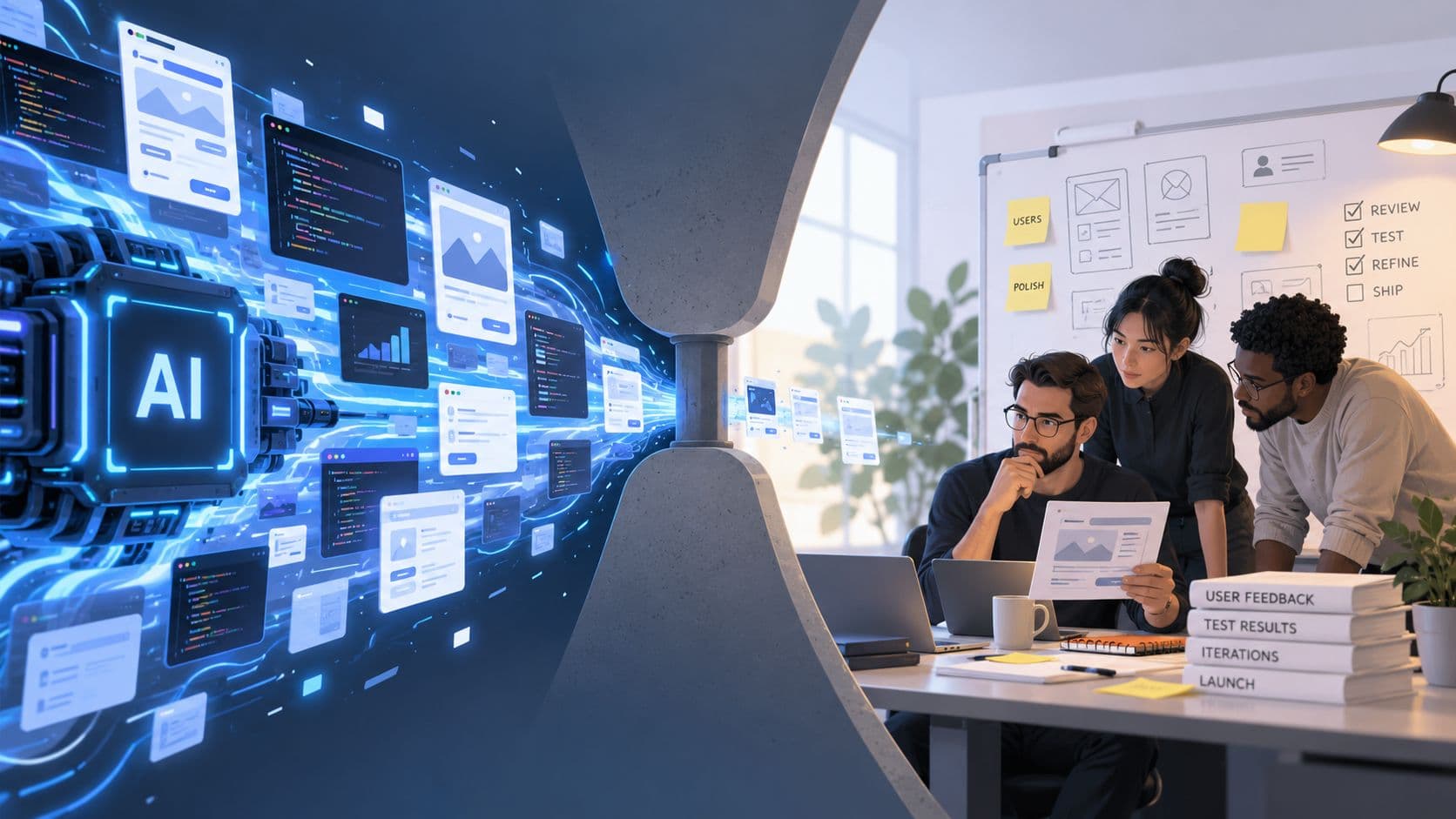
AI can already generate functional applications remarkably quickly. In some cases, much faster than a month. But speed of production is no longer the only variable that matters.
There is another bottleneck, and it is far less scalable: us.
AI may continuously become faster, more capable and more efficient, but the human capacity to process, evaluate and understand what it produces has limits. We can only absorb so much information before our ability to judge it properly begins to decline.
Suppose AI gives you a complete, working application in two weeks. Great.
But is it actually the application your users need?
Would you deploy it immediately, or would you test every important component with real users? Observe how they interact with it? Listen to their feedback? Discover which assumptions were wrong? Refine the experience, adjust the product and then test again?
That process still takes time.
AI can produce the product you requested. But AI is not necessarily the person who will use that product every day. Your customer is.
And understanding that customer cannot simply be accelerated at the same rate as generating code.
Humans weigh alternatives. We question usefulness. We reconsider decisions. We rationalize trade-offs. Most importantly, we experience products in contexts that are messy, subjective and often impossible to capture completely in an initial prompt.
By the end of our conversation, the investor understood the point I was trying to make:
The question is gradually changing.
It is no longer simply: “How fast can AI build this?”
It is becoming: “How fast can humans confidently determine that what AI built is actually right?”
AI's capacity to generate output may continue expanding dramatically. Our capacity to carefully sift through that output will not expand at the same pace.
The next great bottleneck in technology may therefore have very little to do with machines.
It may simply be the speed of human judgment.
Will You Own Anything Anymore?
As hyperinflation continues its relentless monthly climb across many parts of the world, one can't help but recall Alex Kurtagić's remarkably prescient novel, Mister, published in 2008. Set in the 2030s and 2040s, the dystopian story depicts a society where price tags are no longer static but update digitally in real time, responding instantly to inflation and market conditions.
Fifteen years later, that future no longer feels like science fiction.
Electronic shelf labels are already replacing paper price tags in supermarkets.
Dynamic pricing algorithms determine what we pay for airline tickets, hotels, ride-sharing services, and increasingly, everyday products. Prices are becoming fluid rather than fixed.
But perhaps an even greater transformation is taking place—one that extends far beyond inflation.
It is the slow disappearance of ownership itself.
For most of human history, wealth was tangible. We owned land, books, records, cash, paintings, cars, furniture, and shelves full of photographs documenting our lives. Ownership had weight. It occupied space.
Today, those same possessions are quietly evaporating into code.
Your music library became Spotify.
Your films became Netflix.
Your books became Kindle.
Your photo albums became iCloud.
Your software became subscriptions.
Even your computer is shrinking. CD drives disappeared years ago. USB ports are becoming fewer. Physical hard drives are increasingly optional, replaced by cloud storage that exists somewhere you will never physically see.
The objects are disappearing.
What remains is access.
This subtle shift has profound implications. Increasingly, we don't buy products—we rent experiences. We don't own software; we subscribe to it. We don't own our media collections; we lease access until the platform changes its terms, loses a licensing agreement, or simply disappears.
Ownership is becoming a service.
Artificial intelligence is accelerating this transition.
The AI economy places less value on possessing things and more value on accessing intelligence on demand. Instead of purchasing software once, we subscribe to AI assistants. Instead of buying creative tools, we rent computing power. Even knowledge itself is becoming something we query rather than accumulate.
In many ways, AI is transforming intelligence into a utility, much like electricity.
The implications stretch even further.
If AI can write, design, compose music, generate videos, and produce software in seconds, what exactly becomes valuable? Is it the output? The prompt? The algorithm? The computing infrastructure? Or simply access to the system?
Entire industries built around ownership may find themselves disrupted by a generation that grows up expecting to own almost nothing at all.
Even money is evolving.
Cash is giving way to digital payments. Central bank digital currencies are being explored around the world. Cryptocurrencies introduced the idea that ownership itself could exist purely as cryptographic proof rather than physical possession.
Whether one embraces or rejects these technologies, they all point toward the same destination: value is becoming increasingly intangible.
Ironically, the more digital our lives become, the less certain ownership appears.
When your photos live in the cloud, do you truly own them?
When your AI assistant stores your conversations, who owns your memories?
When every creative work can be generated, copied, or remixed by intelligent systems, what does originality even mean?
Perhaps the next generation will not measure wealth by what fills their homes, but by what fills their digital identities. Reputation, data, blue checkmarks, online communities, digital assets, and AI-enhanced capabilities may become the new forms of capital. Maybe NFTs arent as dead as we think, just a social experiment that was deployed a bit too early.
The physical world may gradually become the interface, while the digital world becomes the substance.
Some welcome this transformation. Physical possessions require maintenance, storage, insurance, and eventually replacement. Digital assets offer convenience, mobility, and instant accessibility from anywhere in the world. But who controls your access to it? Remember how in the movie Demolition Man (1996) how your card can get automatically debited for saying a bad word? But I digress.
As ownership migrates into platforms, clouds, and subscriptions, control migrates with it. If access depends on accounts, licenses, or monthly payments, are we still owners—or merely long-term users?
This isn't simply an economic transition. It’s a philosophical one.
For thousands of years, civilization has been built around acquiring, protecting, and passing down possessions. Now imagine a future where you inherit passwords instead of property, subscriptions instead of collections, and digital identities instead of physical legacies, are we witnessing the end of ownership as we have understood it?
Now if AI eventually manages our finances, creates our art, curates our memories, and negotiates on our behalf, will ownership itself become an outdated concept?
More importantly...
In a world where almost everything is accessed rather than possessed, what will we truly be able to call our own?


 Featured